I love the game of handball. I love playing handball games. I love watching handball games being played. The love experience extends beyond the courts. The love is the connections that are lasting between friends that are sometimes pitted against each other on the courts. Nowhere is that love more evident than during the 5-day span that many of us gather at the Lucas County Recreation Center in Maumee, OH, aka Toledo. For 50 years (2020 Pandemic year excepted), handball faithful have journeyed to this hallowed ground to revel and commiserate at one of the great events in our sport. After a two-year absence (one planned and the other, fate said, no), I was delighted to return to the proverbial mecca of handball.
As we celebrate the fiftieth year of holding the tournament on this site, we also celebrate generational changes, both familial and social. The historical perspective of our sport and its traditions, especially here in Toledo, represents both aspects of these changes. Along with these changes come a compendium of stories. Over the years, we have all heard numerous tales of how things were and specifics about players and their families. Depending on who is telling a tale and who is within earshot, there can be collaboration or clarification and even disagreement. In reminiscing, the point of these stories is sometimes to highlight an absurdity or some moment that remains comical or pivotal and still elicits some laughter or head shaking. It is great to hear stories about the very first game that an individual storyteller ever played at this tournament, on these courts. Regarding the teller, the results generally led to some loss or comeuppance. But one commonality of all these stories is the love of the game of handball. Some of the surrounding scenery has changed over the years, but many of the players and their families remain fixtures in the handball landscape.
In competition at this year’s event there are many individuals who were not born until after the initial or inaugural tournament held here in 1975. And to put it all in perspective, there are some who have competed here since 1975 and who have offsprings who are competing in this year’s tournament. Because of the relative longevity of viable competition, our sport allows for the aspect of multigenerations to compete side-by-side, sometimes together or more often, apart. The beauty of handball is that it is often passed on from father to son and in some cases mother or father to daughter. Examples abound in this tournament. If I list one example, I will have to list them all. Suffice it to say, over the years since I began participating in this tournament, I have seen, in the same tournament, Grandfather, Father and Son participate. As part of that generational legacy, the 50th year of playing in Toledo, there are more than a half a dozen brothers teamed together in doubles and/or playing separately in either doubles or singles. There are also several fathers who entered separately from their sons’ entries and one father entered separately from his daughter. Let us not forget, the husband and wives who, in this tournament, are competing separately.
So, the stage is set for the 3-wall national championship debut of the One ball. The One ball has been in play on the national stage at the One-wall national championships and in some 4-wall events. Having played with the One ball for several seasons on the 3-wall surface, I am aware of how this ball reacts when struck against concrete surfaces. I used the word “erratic” to describe the bounce and was immediately corrected by a great player who viewed the term with skepticism but agreed the ball did give some unexpected bounces during play. During the tournament, it was evident that ‘unexpected’ bounces occurred quite frequently. How much those types of bounces affected outcomes may never be quantitatively determined. Perhaps player feedback (positive or negative) will determine the continued use of the One ball for this tournament.
Another debut for the tournament was the use of ACE referee in keeping score. ACE referee is the brainchild of Jeff Wall from Texas. For years, Jeff has been using his cellphone to keep score of any match that he happens to ref. This year, everyone willing to try was able to call matches and keep score using this innovative approach. By downloading the App and initiating its operation, scoring and notable match monitoring functions could be completed using the App. It even handles the “coinflip” that determines the order of who or what team serves first. I would say it is not a steep learning curve associated with this APP. One great feature of the App is that it allows the tournament desk and anyone who has downloaded the App to follow live scoring of one or several matches simultaneously. This feature proved very useful when watching a match being refereed using the App and spectators are unable to hear the score as it is being called by said referee, instead of always yelling, “Hey ref, what’s the score on court #?” By no means is this application perfect. There are glitches to be worked out as the developer has been made aware. Paper and pencil scoring is not dead, but it certainly has seen the writing on the wall that it may soon be a fixture of the past.
Around noon on Thursday, I made my way to the courts to register and check in at the tournament tent/desk. Starting in the parking lot, familiar faces began to appear. There were handshakes that transitioned to hearty hugs and other affectionate exchanges. Verbal exchanges ranged from cordial greetings to some renewed established antic or routine, mostly containing laughter. The mirthful exchanges would continue throughout the weekend because not everyone arrives on the first day of the tournament.
At the same time the renewal of acquaintances was taking place, the weather seemed threatening in a nuisance kind of way. As every player of outdoor handball knows, it only takes a few drops or a short cloud burst to halt or cancel play. As we all stood around and glanced up at the sky, some of us who had checked the local weather forecast via our phones were confident that the current bleakness would pass and sunshine would eventually bathe the courts for the rest of the day and throughout the coming weekend. Should the forecast prove inaccurate, and the courts became temporarily unplayable because of wetness, the Toledo Handball Club was ready to roll out the propane torches and every other drying aid available on hand. The forecast was quite accurate and after a brief delay, the tournament was underway with a few singles matches across skill levels and masters’ divisions.
One of those matches was mine and slated to begin play around 2 PM. I had not played singles in Toledo for many years, and I decided I would enter the 70s bracket. When the tournament draw was announced, with any bracket, one assesses their chances for success. In my case, whether seeded at the top or bottom half of the draw, everyone knows that the path to victory would either go through the returning division champion and number one seed, John Friedrich or the previous year’s finalist and number two seed, Roger Berry. My opening round match pitted me against Terry McQuire, someone I had played in previous years while competing in the various age restricted B divisions. The winner of the match would face Roger Berry.
Terry and I faced off and he took the first game, allowing just 5 points. Between games, I felt confident and relaxed. Two-thirds of the way through the second game, with me leading 14-13, during a rally, I reached for a shot and internally I heard a crack as if one cracked their knuckles. Only, this sound emanated from my right foot followed by a sharp stabbing and crippling pain. Instinctively, I knew what had just occurred. Six years before, while on another handball court, all be it indoors, the same sequence of events befell me through my left foot. Taking the medical time out was only perfunctory because from experience, I knew it was impossible to continue. I barely was able to stand and concede the match to Terry. I was disheartened but not devasted because from the past diagnosis of the Foot and Ankle specialist, I knew the etiology of this malady and its promising prognosis. This is a case of peroneal tendonitis, treatable by rest and a series of prescribed therapeutic exercises. In addition to the prerequisite after match beer, as soon as I returned to the hotel, I began a modified regime of these exercises. Being eliminated from the bracket, I would now focus on whether I could play my doubles match, scheduled for Saturday, in the late afternoon.
Friday, by mid-morning I returned to the courts, purely as a spectator. Visibly limping and moving gingerly, I assured all those who showed concern that I was alright. Empathy and sympathy go a long way towards the healing process. The weather was cool but sunny with blue cloudless skies. A perfect day to watch handball. With a full slate of games scheduled, singles matches across all skill levels and age divisions would be underway.
In singles play, dominance is generally established in the open and age divisions. By rule, winning a skill level nationally automatically disqualifies you from ever competing at that level again. Open players return year after year and have been known to hold dominance like the great Sean Lenning, who at the start of the tournament had amassed a staggering 14 Open singles 3-wall titles. Lenning’s absence at last year’s event broke a long streak of victories in the Open. Each successive year of competition, we all wonder who will have success against this 3-wall court magician. Watching Lenning play handball is a thrill and a treat. It is thing of beauty and generally produces the same awe-inspiring reactions from individual spectators. Not to take away from individual open players who are thrill-making machines, but even they admit that what Lenning does on the court is special.
In the age divisions, dominance can run across the five-year divides and last for decades. The player you competed against at 35, if he is healthy and still competes will still be there as you both age into your 70s. Here is a distinguished list of repeating singles champions who have dominated the competition for several decades with the parenthetical numbers indicating what Masters division they are currently competing and this tournament’s results. So, it is remarkable that Ed Campbell (75s Champion), John Frieidrich (70s Champion), Phil Kirk (65s Champion), Dave Dohman (65s Finalist), Dan Zimet (50s Finalist) have been dominant for so long.
Dominance must begin somewhere and starts with the first of what will become many victories. To this end, Adam Zimet won his first Masters title in the 45s after several previous second place finishes.
In rare dominance, and a unique distinction, it is hats off to Joe Kaplan who, in addition to winning the 50s singles title over perennial champion Dan Zimet, separately during this year (2025) has won 50s singles national titles in One-wall and 4-wall. Joe’s workman like approach to the game has certainly contributed to his breakthrough year. Joe is also a gracious individual on and off the court.
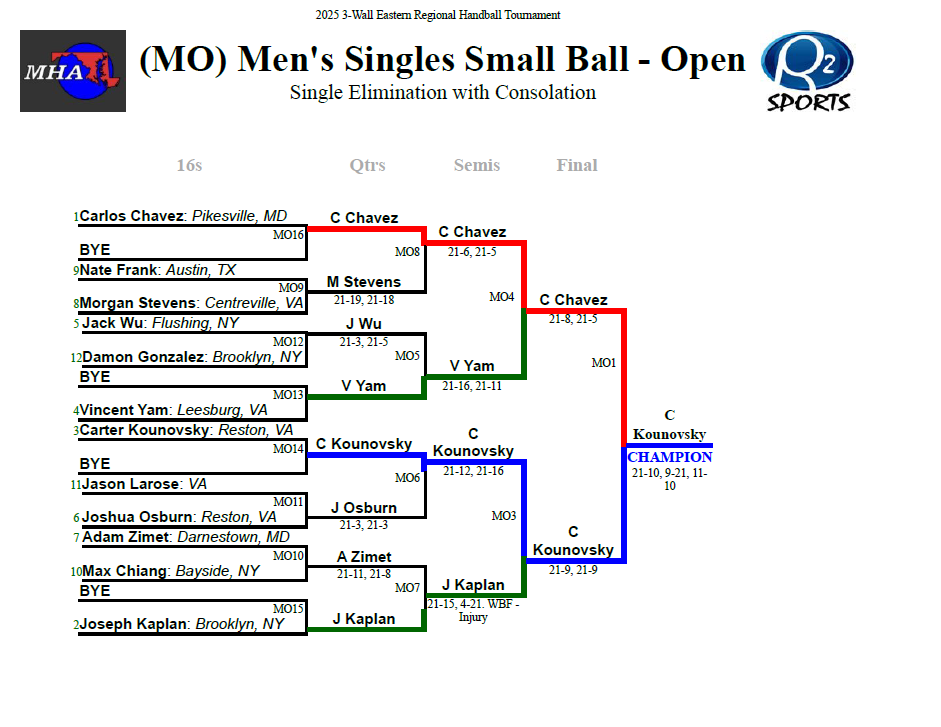
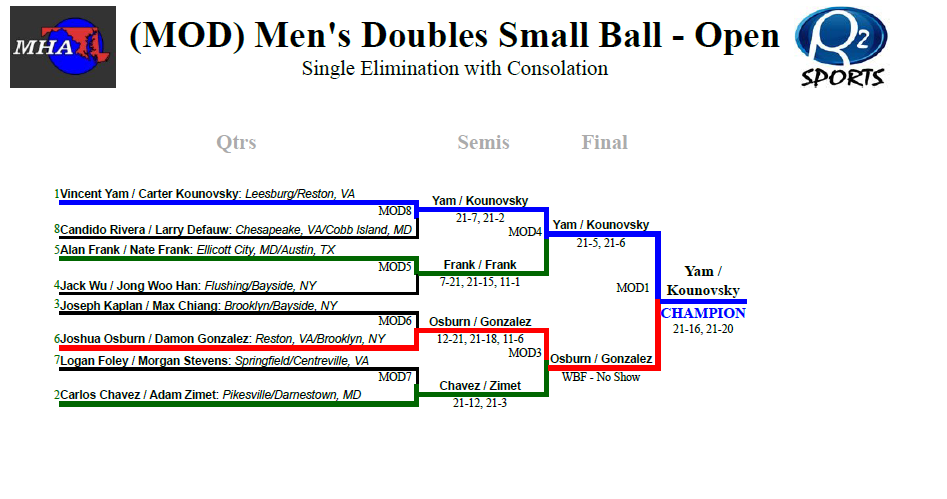
Although dominance is fleeting in the lower skill divisions, it is wonderful to see breakout performances from time to time. This year it is Kudos to Carter Kounovsky for his slamming dominance of the A division. Carter marched through a talented bracket as the number one seed and faced off against a formidable Shawn Walker, seeded second. Shawn has improved his game over the years and presents an imposing figure on the court. He uses his strong returns, great retrievability and an uncanny knack for ending points with well-placed corner kills or straight roll outs. If Shawn has improved, so has Carter. He also possesses many if not all of Shawn’s attributes, but Carter has cut down drastically on his in-game errors and risky shot making. What was on display in his 8 and 9 wins over Shawn was a complete mastery for this newest A singles champion. By Monday, Carter would solidify his dominance at this level and tournament by teaming up with A singles semifinalist Vincent Yam (losing to Shawn Walker) to hold off the tenacious pair of Nathaniel Frank and Sam Worchesky, whose championship aspirations will most likely manifest itself at next year’s tournament.
A note about Vincent Yam. He was the 2024 B singles champion and this year, in shooting to the top rungs of the A level in both doubles and singles, has exhibited a form of the dominance. By default, Carter and Vincent are now Open players and will no doubt find new and greater competition in the years ahead.
The competition that awaits remains fierce.
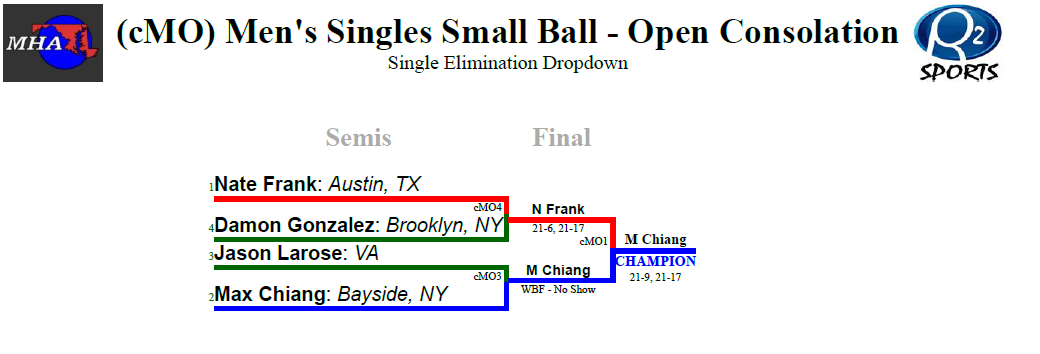
Lenning returned to the Open division hoping to shake off the rust of being absent for a year. After an easy first round win against Dylan Schmitt, next up was Tyree Bastidas, an opponent who he has faced many times before in the finals of this event, but has never lost. To his credit, Bastidas did however secure his lone Open singles 3-wall title in 2013 when he vanquished Emmett Peixoto in an 11-6 tiebreaker. That year, Peixoto squeaked by Lenning in the semifinals. Bastidas’ record in 3-wall notwithstanding, he remains dominant as a One-Waller which includes being the reigning Open singles champion for a total of 11 national Open singles championships. Doing battle in this year’s quarterfinals did not change his fortune in seeking 3-wall glory, as Tyree lost, sending Lenning to the semifinals against relative newcomer, John Bike. As many already know, Bike comes from handball royalty: grandfather, Naty Alvarado, father, John Bike, Jr and mother, Lupe Alvarado. Of course, lineage does not guarantee success, but as we have all seen, it often contributes to steady development. With mom and dad watching, young John Bike took on Lenning, and both thrilled and silenced the crowd as he outplayed his opponent. If you missed seeing the match, word quickly spread throughout the venue about this upset in the ranks. Bike’s stature and demeanor on the court does not resemble that of his great father, except for the dominant left hand. Of note, Bike has not been dedicated to the game until recently, only 3 years, according to his mom Lupe. Bike would later battle a relentless Braulio (Shorty) Ruiz in the finals, only to fall, 19 and 12. On his way to the finals, Shorty took down Daniel and Luis Cordova in the quarters and semifinals respectively. This was Shorty’s first 3-wall open National title after many years of early round exits on this stage. Shorty’s game is simple, drives his opponent back into the deep court with powerful ceiling shots (expanded by the ONE ball), and then waits for the returns which often lead to set ups for kills or other forms of ending a point.
Lenning’s abrupt exit in the singles competition would later find redemption as he and Bike teamed to battle their way through tough competition on their way to the finals against Ivan Burgos and Ray Ure where they prevailed 3 and 12. Lenning would later comment that playing doubles was “really enjoyable.” Understandably, it has been quite a few years since Lenning has been able to claim a doubles crown here in Toledo. The Burgos/Ure pairing is a collaboration worth watching for the future as they showed incredible will and tenacity in the semifinals against the defending champions, Sam Esser and Shorty Ruiz. From all accounts, that match was a highlight of the tournament as the 21-20, 20-21, 11-2 result would indicate. It was the defense and runs by both teams in the games that they split that made the thrills.
The women too can establish dominance since many of them compete in the women’s open division. Now, the dominance belongs to Mikaila Esser (Sam’s wife) as she vanquished Ashley Ruiz (Shorty’s wife) for the singles title and then teamed together to crush in open doubles. This is a repeat of their 2022 championship collaboration for 3-wall.
After full and satisfying day of watching handball games and matches, I returned to the hotel and continued my limited therapeutic regime.
I woke Saturday morning, sore and unsure whether I would attempt to play my scheduled doubles match. As the time grew closer, I decided to play even though I knew how limited my movement would be. My doubles partner, Wes Humphreys, understood the situation. But like me, he was just happy to be on the court. Although we only managed 5 points in each game against the eventual champions, Ray Estevez and Tim Sterrett, we had fun. Quick aside, over the years, separately or with different partners, Ray and Tim are no strangers to the wearing a championship crown. Though painful at times while playing our match, I did not do any further damage to the injured foot, nor did I aggravate or exacerbate the situation. I even fulfilled my obligation by refereeing the next match on the same court which featured two sons of my doubles partner who were competing in the B doubles division. After winning this match and Sunday’s semifinal, Rob and Mike Humphreys would triumph in Monday’s final to claim the championship.
With my 2025 tournament completed, I looked forward to Sunday’s contests that were either finals (singles) or semifinals (doubles).
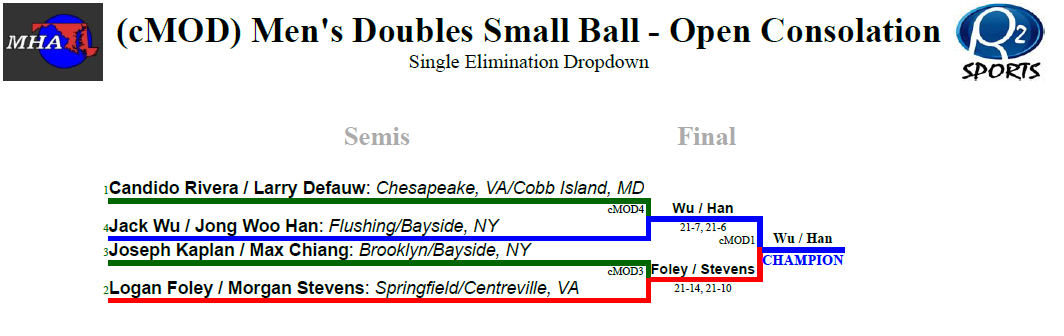
Having discussed or alluded to many of the single’s divisions, matches, and outcomes, I will focus mostly on the doubles portion for the remainder of this treatise. In the Doubles divisions it is more difficult to establish dominance because partnerships are harder to maintain. Whether family members, mostly brothers, pair up or two strong players, the characteristics of doubles generally show a balance of strength and skill between the two people. Roles of each player tend to be clearly defined. Trust between the two players is rarely in doubt.
Over the years of these championships, there have been many successful pairings as these teams age through the divisions. To cite two prominent examples, Dave Dohman and his partners and Phil Kirk and his partners. As the quip goes, success in doubles is choosing the right partner.’
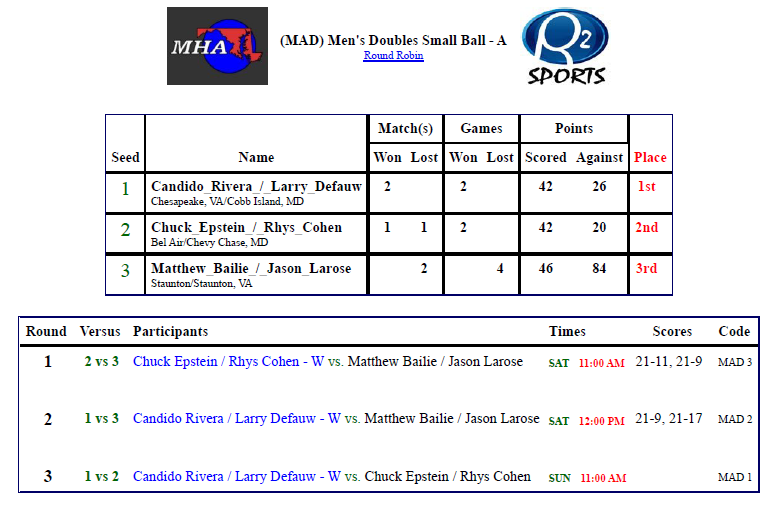
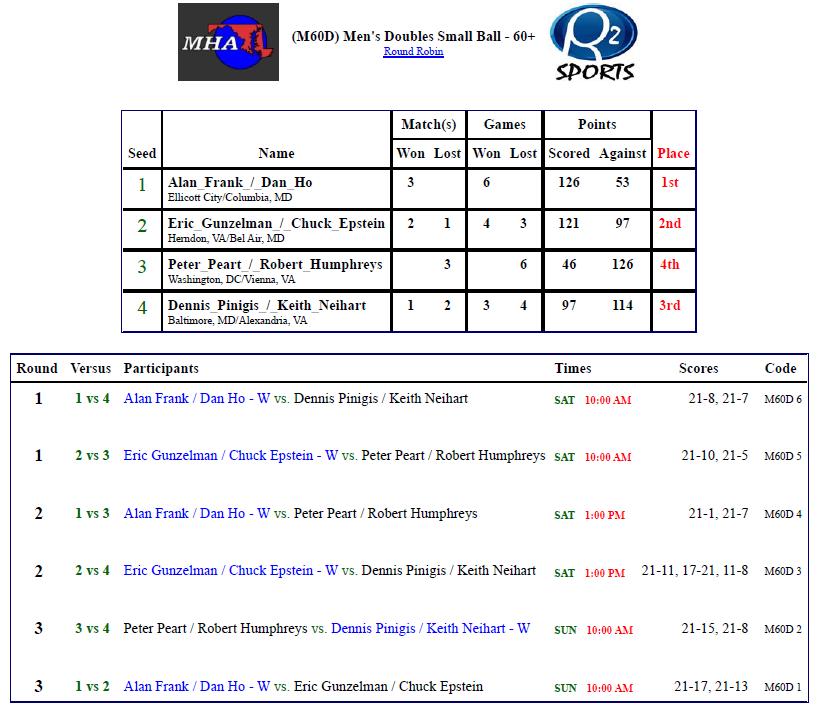
But for consistency and longevity, the doubles tandems that stand out and merits distinction by their incredible winning records are Alan Frank and Mark Zamora (14 championships) and Alan Frank and Dan Zimet (16 championships), with each team successfully competing in the respective master’s brackets separated by 5 years. For example, at this year’s tournament, Frank and Zamora renewed their continued dominance in the 60s doubles after last year, narrowly meeting defeat in an 11-10 tiebreaker against Tommy Valenzuela and his then partner, Augustin Herrera. Their road to this year’s championship was also challenging. Their stellar record of winning championships over the years shows that they are rarely challenged. Opponents generally manage to score less than ten points per game against them. This year, like last year, was different as two matches, especially the finals against this year’s 60s singles champion, Tommy Valenzuela and his new partner, Bernard O’ Sullivan. The finals can accurately be described as a slugfest. Tommy generates incredible power and precision in both his serves and returns. In both games of the match, Frank and Zamora had difficulty in winning rallies that featured Valenzuela. Their only hope was to involve O’Sullivan who was sometimes out of position or unable to return the opponent’s serves. With both games ending at 19, this was the second year in a row with another thrilling final featuring Frank and Zamora since these two began their impressive run and certainty of Monday play at these championships. It is also a redemption from their loss to Valenzuela and his then partner, the year before.
There is also precedence that comes into play regarding Zamora and Valenzuela. For several years running, after Frank and Zamora would lock away their victory in one division, they would then split and form new partnerships of Zamora and Valenzuela and Frank and Zimet to face each other in the division registered 5 years less. With very few exceptions, Frank and Zimet were mostly successful against Zamora and Valenzuela. To see players (Frank and Zamora) who had just competed together and successfully, now going relentlessly against one another is quite fascinating. In a testament to his skills, warrior mentality, and tenacity, Alan Frank emerges from these battles victorious, year after year. But as any true handball fan and/or player knows, Frank is not alone as his partners are proven champions and warriors. As a footnote, this year’s finals in the 55s doubles division was not played due to an injury sustained by one of the finalists, awarding Frank and Zimet the championship, by default. Knowing Frank and Zimet as well as I do, I can easily say, they would rather have secured the victory on the court, even if the outcome of an unplayed match remains unknown.
In other doubles finals contested on Monday this year, the 75s division competitors had an intriguing storyline. Ed Campbell, handball legend, perennial singles and doubles champion was paired with Bob Bardwell who was seeking his 10th national title and thus would achieve Grandmaster status. The Bardwell and Campbell partnership produced the desired results, netting Bob his 10th title and keeping Ed’s stellar winning record intact.
Also ascending to Grandmaster is Adam Szatkowski, who along with Shane Conneely, claimed the 45 Doubles crown.
Keeping the Grandmaster train of continued dominance rolling, congratulations to the Munson Brothers who were awarded their Grandmaster sweaters for their remarkable achievements as doubles partners, winning all but one of their ten titles together. But the one they won apart was with the same partner, Bill Mehilos. And on Monday, the Munsons secured another national championship by winning the combined 35s/40s doubles over Tony Clarke and Cary Dohman, 12 and 1.
As great an individual player as you may be, finding the right person to play doubles with can be both frustrating and fulfilling. Despite Lenning’s current doubles triumph with John Bike as his partner, there was a long drought following the very successful collaboration with Marco Chavez that produced a string of consecutive Open Doubles championships.
In the end, we all know that consistency leads to winning and winning consistently leads to dominance.
These championships are mainly about competition using the One ball, referred to as small ball as a means of distinction from playing with the big ball. There is a period of adjustment going from playing small ball to playing big ball. Big ball play differs in the skill sets and physical approach to the game. At these championships, One-and 3-wall contests were held for men, women and mixed doubles. As the results show, some small ball players transition well to playing big ball and secured medals for their efforts in both disciplines.
Congratulations to all the champions, finalists and participants at this year’s rendition of our 3-wall national championships.
As I alluded to at the start of this piece, it is not just about handball, why we journey to Toledo. The hospitality and welcoming atmosphere provided by the Toledo Handball Club was outstanding as always. The fulfilling flow of food and beverages throughout the tournament was wonderful. The beer was especially cold this year, perhaps the ambient cool temperatures contributed to this delightful bonus. And speaking of beer, it is always a pleasure to share craft brews originating in the Midwest with beer aficionados masquerading as handball players, or vice versa.
The tournament desk and rotating staff were always helpful, informative, and patient. We missed Matt and felt his absence but wished him well and hoped to see him again soon.
It was great to see friends who came just to watch handball and be a part of the atmosphere. I am giving shout out to Pat Lowery who traveled from Florida just to be here again after a long absence. And even though Pat no longer plays, he is still full of stories (some may jokingly say, ‘he is full of other things…’) for a place he has many fond memories. I was glad to see my friend, and we got to spend some time together while watching handball and drinking beer. Life is good.
Another great aspect of the landscape of our game is how the action is so artfully captured by Keith Thode. His still shots freeze the action and give you long sequences that would otherwise pass in a blur in real time and even in videos. The photos take you inside the action where the visceral meets the sublime. These are moments captured for posterity.
In case you want to see photos from Keith’s archive, including these championships, here is a link: https://keithsphotos.toadworld.net/
Finally, and not in the least, I would like to acknowledge and thank Nan for all her support throughout the years. She has been with me through victories and losses and agonized over my recent injury. I am forever grateful for her love and support.
Naturally, I also appreciate all the encouragement and support from local and distant players and their families and friends. In the end, we are just one big family that unites for the love of the game.
These are the memories and moments that keep us connected, and coming back each year. ❤️